How to calculate freight charges: No hidden business fees

How to calculate freight charges? International freight charges are calculated by multiplying chargeable weight by the rate per unit, then adding any applicable surcharges. In logistics, chargeable weight is the greater of the shipment’s actual gross weight and its dimensional (volumetric) weight, which accounts for light but bulky cargo.
However, to accurately plan the total cost of importing a shipment, businesses also need to factor in local charges, duties, and customs fees.
In this article, SpeeGo breaks down the freight calculation formulas for ocean and air freight, identifies the hidden surcharges that are often overlooked, and provides a professional quote-review checklist to help you keep your logistics budget under control.
What are freight charges?

An overview of freight charges in global logistics.
Freight charges are the fees a business pays to move goods from origin to destination. They are not fixed. They vary by carrier, shipping distance, and shipment weight.
Understanding how freight charges are calculated helps you budget proactively and gives you a solid basis for evaluating the quotes you receive from freight forwarders.
What do international freight charges include?
A standard international freight cost structure has three core components: the base freight rate, surcharges, and origin/destination charges. The base rate is the amount paid directly for the ocean or air leg of the journey.
Carriers also add surcharges to offset operating fluctuations. The most common are fuel surcharges, security fees, and cargo handling fees at the port or airport. Finally, origin and destination charges cover supporting services such as pickup, delivery, customs clearance, and cargo insurance.
How do freight charges differ from total landed cost?
In import operations, freight is only one component of the total landed cost of a shipment. If you look only at the rate per kilogram (kg), you will not see the full amount you actually pay.
To help you avoid budget shortfalls, the table below breaks down the main cost categories to prepare for:
| Cost category | Components |
| Freight charges | The main carriage rate plus carrier-imposed surcharges. |
| Origin and destination charges | Pickup, delivery, loading and unloading, and storage fees. |
| Duties and customs fees | Import duties, Merchandise Processing Fee (MPF), Harbor Maintenance Fee (HMF), and customs clearance fees. |
| Other costs | Cargo insurance and inland transportation. |
Understanding each of these categories is the most important step before applying the freight calculation formulas below.
What is the general freight calculation formula?

The general formula for calculating total freight charges.
To determine transportation costs transparently, logistics professionals typically use a basic calculation method. The general freight calculation formula is:
Total freight charges = Base rate + Distance charge + Weight charge + Surcharges − Discounts (if any)
Keep in mind that this formula is for reference only. Every carrier has its own rate schedule and its own calculation rules.
Components of the freight calculation formula
Each component of the formula plays a specific role in reflecting the actual cost of operations:
- Base rate: The standard starting rate set by the carrier. It typically varies by the nature and type of cargo;
- Distance charge: Calculated by multiplying the total distance traveled by the rate per kilometer or mile;
- Weight charge: Calculated by multiplying the shipment’s weight by the rate per unit of weight;
- Surcharges: Fees that cover special services or additional costs, such as liftgate service, door-to-door delivery, or hazardous materials handling;
- Discounts: Rate reductions that carriers typically offer based on high shipping volumes or negotiated agreements with a customer.
Freight calculation formulas by transport mode
Each transport mode (ocean, air, and road) has its own operating characteristics, so the way freight is calculated differs for each. The table below summarizes the core formulas:
| Transport mode | Definition | Core formula |
| Air freight | Cargo shipped by aircraft, suited to high-value goods that need fast delivery. | Chargeable weight × rate per kg. |
| Ocean freight (LCL) | Less-than-container-load: a small shipment that doesn’t fill a container and is consolidated with other shippers’ cargo. CBM (cubic meter) is the unit of volume. | The greater of volume (CBM) or weight (metric tons) × rate. |
| Ocean freight (FCL) | Full container load: the shipper books an entire container for its cargo. | Flat rate per standard container size (typically 20-ft or 40-ft). |
| Full truckload (FTL) | Booking an entire truck for domestic or cross-border road transport. | Miles (or distance) × rate per mile. |
Knowing basic terms like FCL, LCL, and CBM will help you read quotes with confidence and make better cost decisions for your supply chain.
What are the hidden costs of importing?

Learn about the key hidden costs involved in the process of importing goods
When importing, businesses often find that their actual total cost is higher than expected because of “hidden costs”.
These costs usually fall outside the main freight rate and fall into three major categories: origin charges, carrier surcharges, and destination port charges.
Hidden costs at origin (China, Vietnam)
At export hubs such as China and Vietnam, hidden costs typically arise from documentation, export customs clearance, and cargo handling.
According to Topway Shipping, these charges become “hidden” mainly because the seller and the freight forwarder don’t agree up front on who is responsible for paying them. Responsibility for these costs depends entirely on the Incoterms the parties have chosen.
Pay particular attention to the following items:
- Export documentation fees: Often missing from the initial quote and billed separately after the shipment is delivered;
- Export customs clearance fees: Easy to misunderstand, since the seller and the forwarder may each assume the other will pay;
- Origin THC (Terminal Handling Charge): The fee for handling containers at the port of loading. It is often left out when a quote shows only the ocean freight rate;
- Palletizing and repacking fees: Unexpected charges that arise when the supplier’s original packaging doesn’t meet transport safety standards;
- Domestic trucking surcharges: Added when a truck waits longer than the free time allowed for loading, or when the warehouse is in a remote area.
Carrier surcharges on the ocean leg
Industry experts note that carrier surcharges are added on top of the base rate and can account for a significant share of the final freight bill. A transparent freight forwarder itemizes each surcharge line and warns customers in advance whenever a carrier plans a General Rate Increase (GRI).
To review a quote effectively, make sure you understand these common abbreviations:
- BAF (Bunker Adjustment Factor): A fuel surcharge that offsets fluctuations in global fuel prices;
- CAF (Currency Adjustment Factor): A surcharge that protects carriers against exchange rate fluctuations;
- LSS (Low Sulphur Surcharge): Applied when carriers must use low-sulfur fuel to comply with environmental standards;
- GRI (General Rate Increase): A general freight rate increase that carriers announce to take effect on specific dates;
- PSS (Peak Season Surcharge): A surcharge applied during peak shipping periods, such as around Lunar New Year and the holidays, when demand surges;
- THC (Terminal Handling Charge): The fee for handling and moving containers at the origin and destination ports;
- Other operational surcharges: According to Topway Shipping, you may also face port congestion surcharges, container imbalance fees, or rollover fees (incurred when cargo misses its sailing and has to wait for the next vessel).
How is total landed cost calculated for imports?
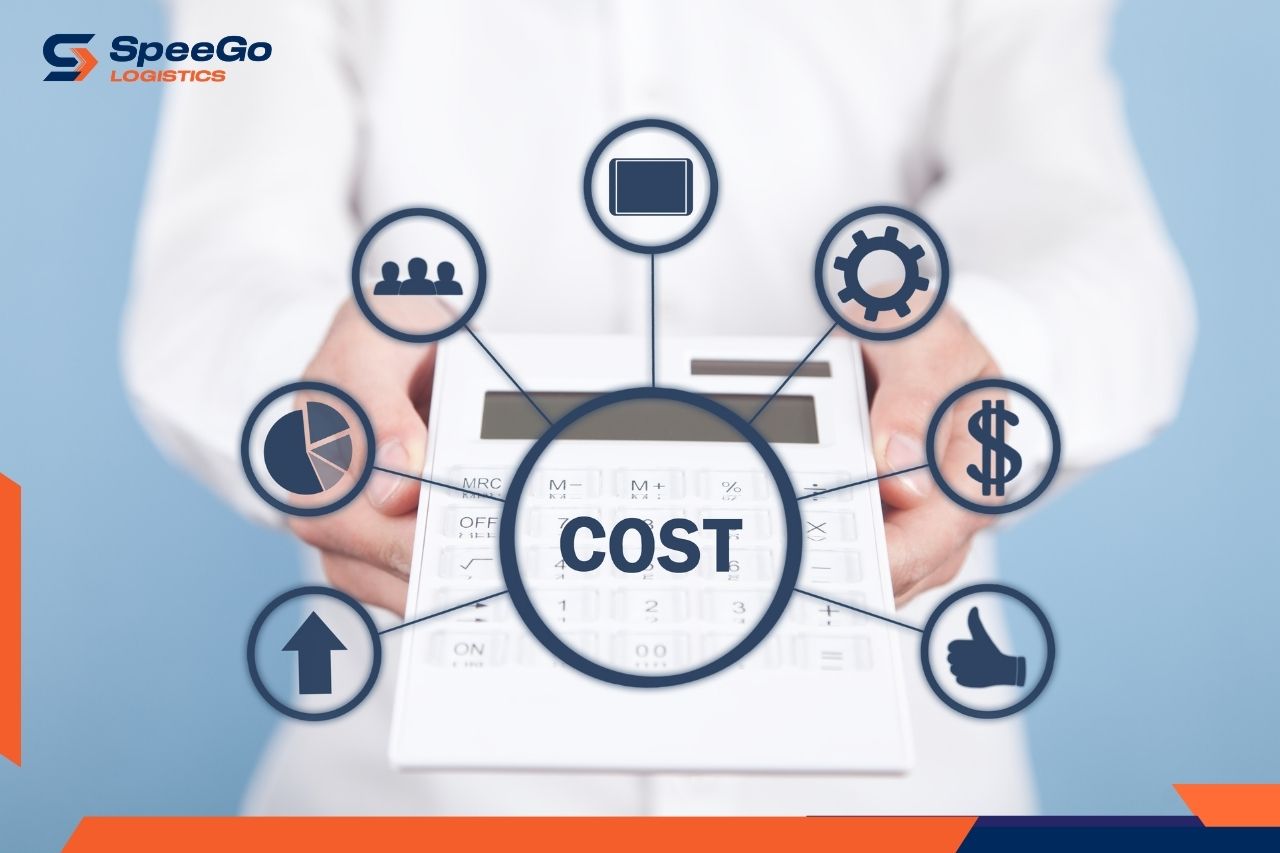
The formula for calculating total landed cost to budget your imports accurately.
To budget accurately, you need to determine your total landed cost. This is the full amount you actually pay to bring goods from the supplier to your warehouse.
Knowing this formula helps you estimate the cost of moving goods as precisely as possible, set sound selling prices, and avoid budget overruns.
Total landed cost formula
According to ExFreight, a standard total landed cost is built from the following items:
Total landed cost = Cost of goods + International freight charges + Insurance + Import duties + MPF (Merchandise Processing Fee) + HMF (Harbor Maintenance Fee) + Customs brokerage fees + Inland transportation + Other incidental costs
Import duty is calculated by multiplying the customs value of the goods by the applicable duty rate. The duty rate is not fixed. It varies by the product’s HS code.
Example: Calculating Costs for a $20,000 Shipment Imported Into the U.S.
When importing goods into the U.S., businesses must pay the Merchandise Processing Fee (MPF). If the shipment arrives by ocean, they must also pay the Harbor Maintenance Fee (HMF). The table below summarizes the rates in effect as of October 1, 2026:
| Fee | Rate |
| MPF (U.S. Customs merchandise processing fee) | 0.3464% of the value of the goods, with a minimum of $34.58 and a maximum of $670.86 (per Livingston). |
| HMF (U.S. harbor maintenance fee) | 0.125% of the value of the goods. Applies to ocean shipments only and has no maximum (per Tariff Lens). |
To illustrate, suppose your business imports a $20,000 shipment by ocean. The estimated budget items are:
- MPF: $69.28;
- HMF: $25 (because the shipment arrives by ocean);
- Cargo insurance: Insurance premiums on the market typically range from 0.3% to 0.8% of 110% of the contract value. For this shipment, that works out to roughly $66 to $176. This is an approximation and does not include freight charges;
- Other costs: According to GingerControl, importers must also pay for the Importer Security Filing (ISF), a customs bond, and the services of a customs broker.
How to reduce import freight costs
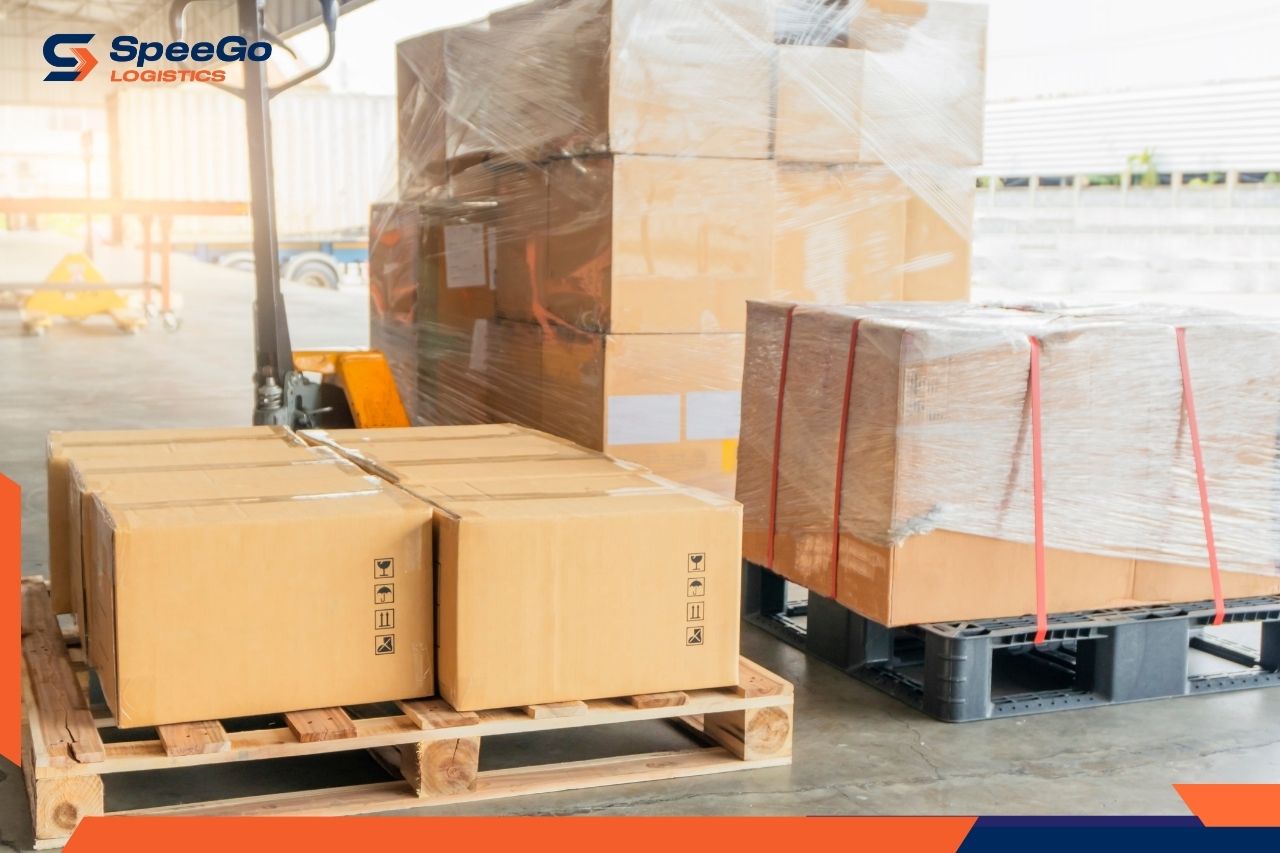
Core strategies to effectively reduce import freight costs
Businesses can take proactive steps to cut freight costs through the following core strategies:
- Optimize packaging: Use right-sized packaging to eliminate excess space, which directly reduces the dimensions and chargeable weight of the shipment;
- Consolidate shipments: Combine small shipments to share transport space. According to FedEx Freight, this approach is very effective at reducing costs for orders that don’t require urgent delivery;
- Plan shipments early: Lock in your shipping schedule well in advance to avoid the risk of expensive expedited shipping surcharges;
- Negotiate contract rates: If your import and export volumes are steady, use that leverage to negotiate long-term contract rates;
- Leverage a 3PL or freight forwarder’s network: Rather than negotiating on your own, partner with a freight forwarder. Forwarders move large combined volumes, which helps them secure cheaper, more competitive rates from carriers;
- Choose the right Incoterms: Agree on Incoterms (International Commercial Terms) with your trading partner so that responsibility for each cost is clearly defined, helping you control the risk of unexpected charges at the destination port.
Knowing how to calculate freight charges and spotting hidden surcharges early are key to controlling your budget and protecting your profit margins. If you need to estimate the actual cost of your shipments, especially on trade lanes from Vietnam or China to the U.S., Canada, and Australia, contact the SpeeGo team for a free consultation and a detailed quote.
Visit the SpeeGo Logistics website regularly for in-depth insights on import/export operations and supply chain optimization solutions.
Related Articles