
Import nail products: A complete guide for businesses
To import nail products means bringing nail polish, gel polish, press-on nails, and nail tools from overseas into a target market such as the US, Canada, or Australia. Anyone looking to import nail products needs to meet FDA requirements, classify HS codes correctly, and manage landed cost carefully.
In this guide, SpeeGo Logistics walks you through the current state of the nail products import market, the most common product categories, key compliance rules, the HS codes you need to know, a step-by-step process, how to calculate cost, and what it takes to import successfully.
Market overview for nail products imports

The global supply chain landscape for nail cosmetics and salon supplies
The global nail products market keeps growing at a steady clip, and demand to import nail products is rising right along with it in major consumer markets. That’s opened up real opportunities for Vietnamese businesses, particularly as intermediaries sourcing from China and reselling into the US.
Leading importing countries
The US is the largest market to import nail products into, backed by a network of more than 58,000 nail salons nationwide, most of them Vietnamese-owned. Canada and Australia are also significant import markets, with demand for nail products climbing steadily alongside broader personal care trends. All three markets favor suppliers who can back up their products with clear safety documentation.
Leading exporting countries
China is the world’s largest exporter of nail products, supplying the bulk of nail polish, press-on nails, and nail tools sold in the US. China held a 30.5% share of the Asia-Pacific market in 2025, a lead built on concentrated raw-material supply chains and manufacturing capacity. South Korea and Vietnam also export nail products, but at a much smaller scale than China.
Market trends and current demand
Demand for nail products keeps climbing, driven by personal grooming trends and social media influence.
The global nail care products market was valued at $23.5 billion in 2025 and is projected to reach $25 billion in 2026, growing at a 7.1% CAGR – Source: Global Market Insights.
Nail polish alone accounts for roughly 67.58% of the nail care products market in 2026, making it the single most-imported and most-traded product line in the category. That’s exactly why nail polish and gel polish remain the top priority for businesses planning an import order.
Common types of nail products imported
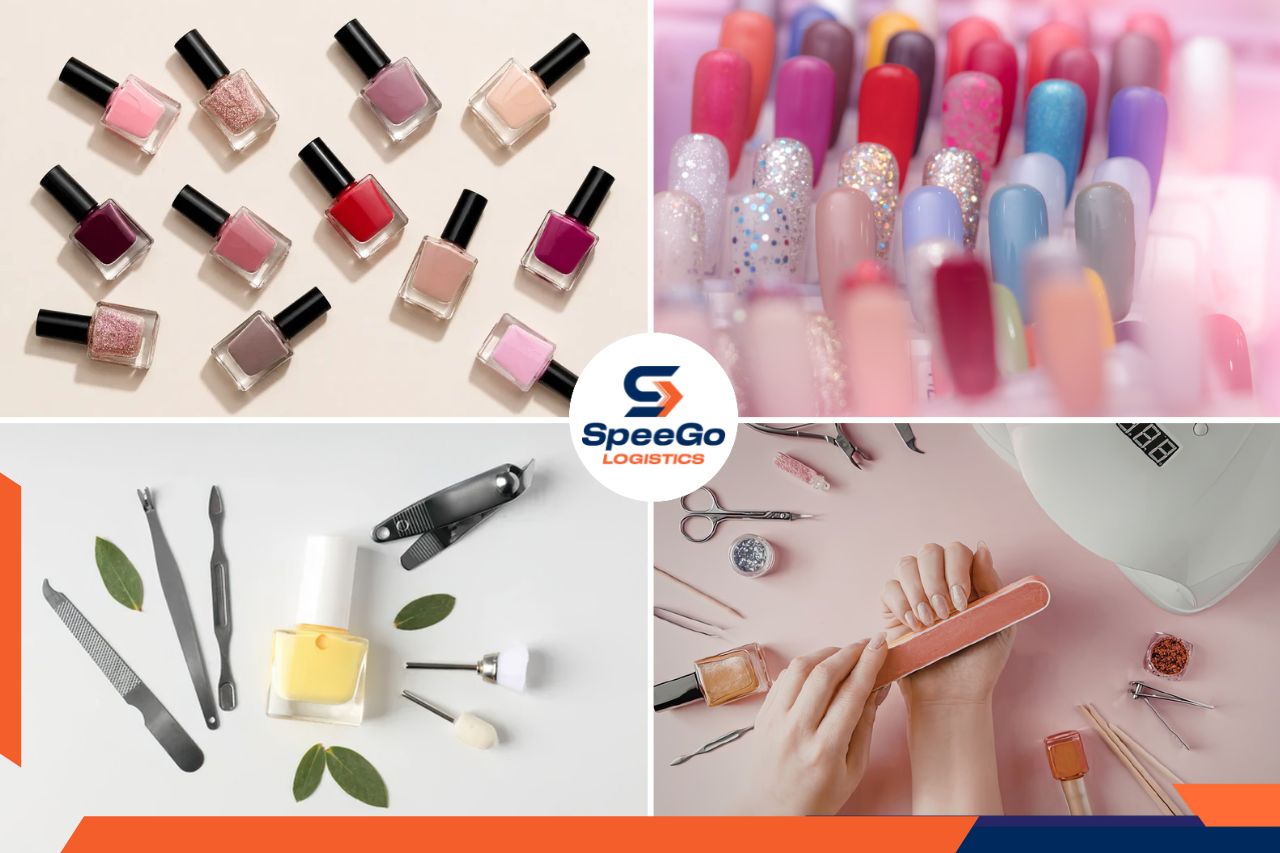
Imported nail products generally fall into four categories: nail polish/gel polish, press-on nails, nail tools, and nail care products. Each category carries its own HS code, regulatory profile, and compliance risk, so it’s worth sorting products into the right bucket before you place an order.
Common types of nail products imported
Navigating compliance and product categorization for wholesale nail supply imports
Imported nail products generally fall into four categories: nail polish/gel polish, press-on nails, nail tools, and nail care products. Each category carries its own HS code, regulatory profile, and compliance risk, so it’s worth sorting products into the right bucket before you place an order.
Gel polish and regular nail polish
This is the core category, covering traditional nail lacquer, UV/LED gel polish, base coats, and top coats. It falls under FDA cosmetics oversight, so ingredient control matters. Ask your supplier for a complete INCI ingredient list before you commit to an order.
Press-on nails
Press-on nails are one of the fastest-growing segments, driven by convenience – no salon visit required. They’re classified as a plastic product rather than a cosmetic, which means a different compliance path than nail polish. Press-on nails are also a top-selling item among Vietnamese sellers moving nail products through Amazon and TikTok Shop in the US.
Nail tools and equipment
Nail tools include cuticle nippers, nail files, UV/LED curing lamps, e-files, and manicure sets. Metal tools (nippers, files, clippers) are regulated as ordinary hard goods, not cosmetics. UV/LED lamps are the exception – they may need electrical safety certification depending on the state you’re shipping into.
Nail care and treatment products
This category covers cuticle oil, hand cream, polish remover, and nail repair serum. Some of these products contain alcohol or flammable solvents (acetone, for example) and need to be declared correctly as hazardous goods for transport. Talk to your logistics provider early about flammable liquid shipping rules before you consolidate a shipment.
Key regulations and compliance requirements

Key regulations and compliance requirements for importing nail products
Compliance isn’t optional when you import nail products into the US, Canada, or Australia – it’s a hard requirement. Getting it wrong can get a shipment held at port or destroyed outright.
FDA regulations for importing nail products into the US
The FDA classifies nail polish as a cosmetic, in the same bucket as lipstick, moisturizer, and eye makeup. Under MoCRA, the FDA doesn’t require premarket approval for most cosmetics – color additives are the exception – but the importer still carries full responsibility for product safety. Manufacturing facilities must register with the FDA, and the responsible person must file a product listing every two years.
Labeling is tightly controlled too. Retail packaging needs a principal display panel and an information panel that clearly states the product identity, net quantity, manufacturer or distributor information, and a full ingredient list – all in English. A single labeling error is enough to get an entire shipment refused at the port of entry.
FDA oversight of imports has also stepped up. The agency regularly issues Import Alerts – the 53-series, for example – targeting issues like heavy metal contamination, undeclared drugs, or microbial contamination. In early 2026 alone, the FDA rejected more than 100 cosmetics shipments for these reasons (Source: FreightAmigo).
REACH, CPNP, and Responsible Person requirements in Europe
If you’re planning to expand into the European market, factor in REACH chemical regulations and CPNP (Cosmetic Products Notification Portal) requirements. Nail products sold in the EU must have a Responsible Person based in Europe who carries legal accountability for the product’s safety file. That’s a meaningful departure from the US, Canada, and Australia – the markets SpeeGo currently serves.
Key regulations by market
Beyond the US, Canada and Australia each have their own regulatory bodies overseeing nail product imports.
| Market | Regulatory body | Core requirement |
| US | FDA (under MoCRA) | Facility registration, product listing, full English labeling |
| Canada | Health Canada | Cosmetic Notification filed within 10 days of sale |
| Australia | TGA/ACCC | Compliance with consumer safety standards; bilingual labeling where required |
If you’re selling across multiple markets, standardize your ingredient documentation and labeling up front instead of building separate versions for each country – it saves both time and money.
Restricted and banned ingredients
Nail polish has historically contained the “toxic trio” – toluene, formaldehyde, and dibutyl phthalate (DBP) – which is now addressed across several overlapping regimes: Prop 65, California’s AB 2762 intentional-addition ban, AB 2771 PFAS reporting requirements, and DTSC’s Priority Product rule. California’s AB 2762 ban took effect January 1, 2025 (Source: Prop65Compliance).
Methylene chloride is another ingredient worth flagging specifically. It’s fully banned in cosmetics, yet the FDA has continued to find it in some imported gel polish removers from 2024 through 2025, prompting a public advisory. Get written confirmation from your supplier that these substances aren’t used in their formulations.
HS code classification for nail products
Researching and classifying HS codes for common nail care products
Getting the HS code right determines your duty rate and keeps you clear of retroactive duty assessments after clearance. Every nail product category carries its own HS code – don’t classify an entire order under a single catch-all code.
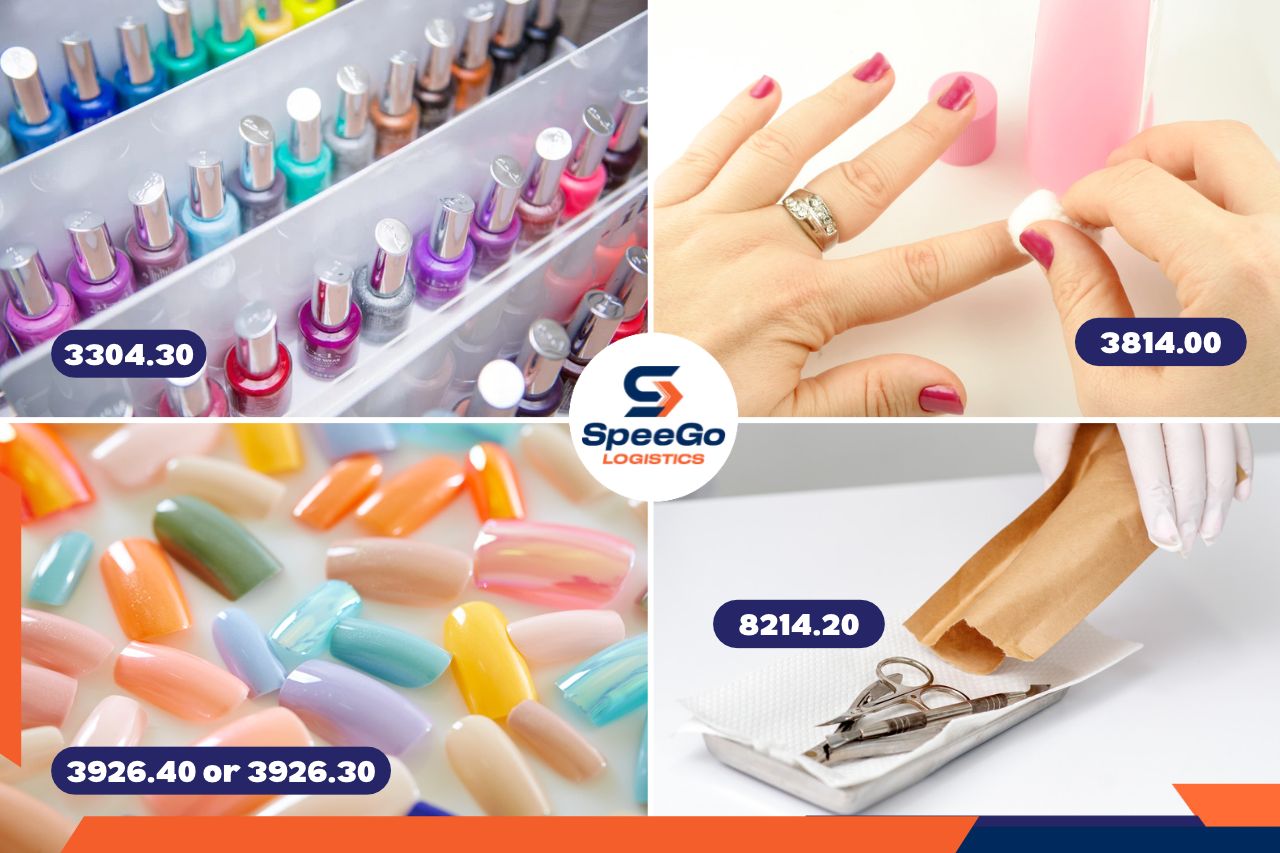
Reference table of common HS codes for nail products:
| Product | HS code | Category |
| Nail polish, gel polish | 3304.30 | Cosmetics |
| Nail polish remover (acetone-based) | 3814.00 | Organic solvents |
| Plastic press-on nails | 3926.40 (or 3926.30) | Plastic articles |
| Metal manicure/pedicure tools | 8214.20 | Metal tools |
HS code for nail polish and gel polish
Nail polish, gel polish, and other manicure preparations fall under HS code 3304.30, within Chapter 33 (cosmetics).
The full US classification is 3304.30.00, carrying a 0% MFN duty rate – though goods of Chinese origin still owe additional Section 301 duties under current rules. Polish remover (acetone-based) is classified separately under 3814.00 (mixed organic solvents), outside the 3304 heading entirely.
HS code for press-on nails
Per an official CBP classification ruling, plastic press-on nails fall under HS code 3926.40.0000, covering other ornamental articles of plastic – distinct from nail polish, polish remover, and cuticle cream, which sit under 3304.30.
Some classification databases list press-on nail kits with pre-applied adhesive under 3926.30 instead, so it’s worth requesting a product-specific binding ruling to avoid a misclassification.
HS code for nail tools
Metal manicure and pedicure sets and instruments, including nail files, fall under HS code 8214.20, in Chapter 82 (base metal tools).
This code covers cuticle nippers, nail clippers, tweezers, and boxed manicure sets. UV/LED curing lamps are classified separately under electrical equipment codes, outside the 8214 heading.
Why accurate HS classification matters
A misclassified HS code means you either underpay or overpay duty, and either one can trigger a retroactive assessment or a penalty from customs. When a single container carries multiple nail product categories, declare each one under its own HS code rather than lumping them together.
At SpeeGo, our documentation team reviews HS classification with clients before filing, which cuts down the risk of a shipment getting held at the destination port.
Step-by-step process to import nail products
Import process for nail products for new businesses
Importing nail products comes down to six core steps, from sourcing a supplier through to customs clearance at the destination port. Skip any one of them and you’re adding risk of delay or unplanned cost.
Step 1: Find and vet a reliable supplier
Start by sourcing through B2B platforms like Alibaba and 1688, or beauty industry trade shows in Guangzhou and Yiwu. Verify the supplier’s business license, production capacity, and export track record before putting down a deposit.
Prioritize factories with existing US export experience – they already understand labeling and ingredient requirements.
Step 2: Order samples and evaluate quality
Always request samples before committing to a bulk order. Test color adhesion, durability, scent, and texture under real-world conditions.
Where possible, send samples to an independent lab for ingredient testing to confirm they’re free of restricted substances.
Step 3: Negotiate MOQ, pricing, and Incoterms
MOQ (minimum order quantity) for nail products typically runs 500 to 3,000 units per SKU, depending on the factory. Nail down clear Incoterms – FOB (free on board) and EXW (ex works) are the two most common.
First-time importers generally do better with FOB, letting a logistics partner like SpeeGo handle international transport and reducing exposure to variables outside their control.
Step 4: Prepare the import documentation
Core documents include a sales contract, commercial invoice, packing list, bill of lading, and a certificate of origin (C/O) if you’re claiming preferential duty treatment.
For cosmetics, add an INCI ingredient list and a safety data sheet (SDS) if the shipment includes flammable substances.
Step 5: Choose a shipping method
Your shipping method choice has a direct effect on both cost and delivery timeline.
| Criteria | Ocean freight | Air freight |
| Transit time (China – US) | 30 – 45 days | 5 – 10 days |
| Cost | Lower, better for larger orders | Higher, better for urgent orders |
| Best for | Recurring, high-volume restocks | Rush orders, new sample runs |
Ocean transit time from China to the US typically runs 30 to 45 days, depending on the route and carrier. At SpeeGo, a nail products shipment moving from Yantian Port (Shenzhen) to Long Beach typically takes about 30 to 32 days, including basic clearance time.
Step 6: Complete customs clearance
Once the shipment reaches the destination port, the importer (or their customs broker) files the entry along with the supporting documents for customs review.
For cosmetics, customs may coordinate with the FDA for additional label and ingredient checks. Having complete documentation ready from the start shortens clearance time and helps you avoid demurrage fees.
How to calculate landed cost when importing nail products
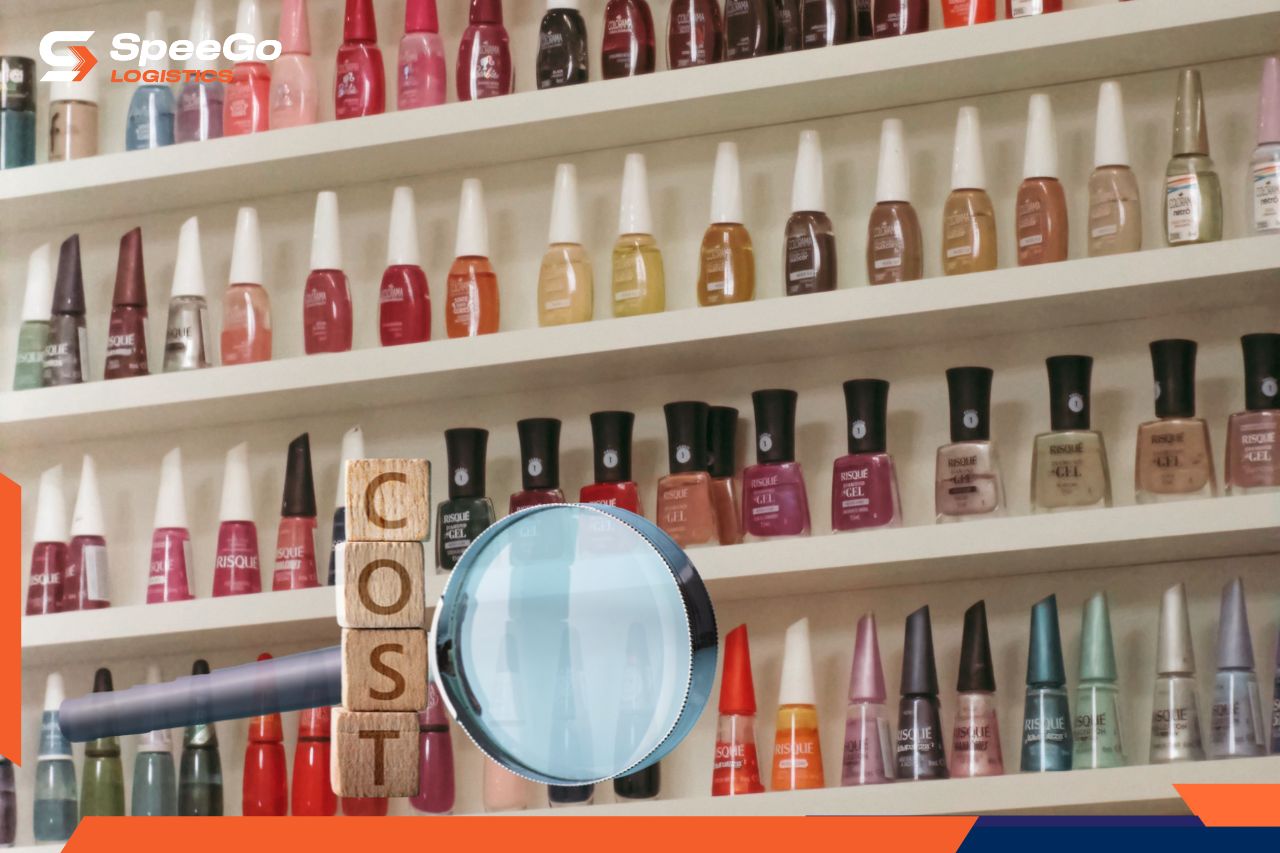
How to calculate import costs for nail products
Landed cost is the true total cost of getting a nail product from the factory to a warehouse in the US, Canada, or Australia. Getting landed cost right is what lets you price accurately and avoid margin loss from underestimating costs.
Cost components (product price, freight, duty, fees)
Landed cost breaks down into five main components: product cost (FOB/EXW), international freight, import duty, customs clearance fees, and inland freight at destination. On top of that, factor in cargo insurance, storage fees for delayed pickup, and documentation processing fees.
One important note for 2026: the $800 de minimis exemption has been suspended entirely, for every country of origin – not just China. That means every shipment, regardless of value, now requires a formal customs entry and full duty payment, with no exemption available the way there used to be.
How to calculate landed cost accurately
Landed Cost = Product Cost + Shipping + Insurance + Customs & Duties + Local Charges
Hidden costs to watch for
New importers often miss a few line items: additional FDA inspection fees if a shipment gets flagged for testing, container demurrage if clearance runs long, and relabeling costs if a product doesn’t pass compliance the first time. Build in an extra 5 – 10% buffer on top of your initial landed cost estimate.
Common challenges when importing nail products
Common risks for new businesses importing nail care products
Importing nail products carries risks that go beyond typical consumer goods, largely because of the cosmetic chemistry and safety regulations involved.
Inconsistent quality
Nail products from smaller Chinese factories often show quality variation from batch to batch. Color, adhesion, and scent can shift even under the same product code. Testing a sample from every batch – not just once at the start of the relationship – is the best safeguard against this.
Unreliable suppliers
Some suppliers claim safe ingredient formulations that don’t match what’s actually in the product, creating FDA compliance risk once the shipment lands in the US. Favor factories with cosmetic GMP certification and a stable track record exporting to the US, Canada, or Australia.
Regulatory compliance risk
Cosmetics regulations change frequently, particularly in California under laws like AB 2762 and AB 2771. Businesses that don’t keep up can end up with held shipments or penalties after products are already on shelves. Assign someone to track regulatory updates on an ongoing basis, rather than checking once at the start.
Logistics and shipping issues
Flammable liquid products (polish remover, some gel polishes) require dangerous goods (DG) declaration for transport, adding cost and paperwork. Get the declaration wrong, and the shipment can be refused for transport or penalized at the port.
Communication barriers
Language gaps with Chinese factories can lead to miscommunication on specifications, particularly around ingredient lists and English labeling requirements. Working through an intermediary or sourcing partner with staff fluent in both Chinese and destination-market regulations helps close that gap.
What it takes to import nail products successfully
Getting the controls right from the start is what lets a business reduce risk and keep costs down over the long run.
Choosing a trustworthy supplier
Prioritize factories with valid cosmetic manufacturing licenses, willingness to share safety documentation (SDS, INCI ingredient list), and export experience into the US. Check reviews from previous clients, and ask for either an in-person factory visit or a video walkthrough if travel isn’t an option.
Practicing solid quality control
Build a standing quality checklist for every shipment: color, adhesion, packaging, labeling. Keep a reference sample from each batch to compare against later if a customer complaint comes in. Spot-check product before container loading rather than relying solely on the factory’s own report.
Building long-term supplier relationships
Sticking with a small set of reliable suppliers long-term typically earns better pricing and priority production slots during peak season. Paying on time and communicating clearly when quality issues come up builds trust in both directions.
Partnering with a sourcing or logistics provider
A sourcing or logistics partner with nail industry experience shortens supplier search time, tightens quality control, and keeps documentation aligned with FDA requirements. SpeeGo Logistics supports clients end to end – from supplier connections and factory inspections to shipping and customs clearance into the US, Canada, and Australia.
Related Articles


FAQs about importing nail products
1. Do I need FDA approval to import nail products into the US?
No premarket FDA approval is required for most nail products, with color additives as the exception. That said, the manufacturing facility must register with the FDA, and the importer carries responsibility for product safety and labeling once it enters the US.
2. What’s the HS code for nail polish and gel polish?
Both nail polish and gel polish fall under HS code 3304.30, the manicure preparations category. Polish remover (acetone-based) is classified separately under 3814.00, outside the nail polish category.
3. How much does it cost to import gel nail polish from China?
Cost depends on FOB price, shipping method, and applicable duty by country of origin. As of 2026, every shipment owes full duty since the $800 de minimis exemption has been suspended, so it’s worth calculating the full landed cost rather than a rough estimate.
4. What’s the minimum MOQ for importing nail products?
A typical MOQ runs 500 to 3,000 units per SKU, depending on the factory and product type. Press-on nails generally carry a lower MOQ than nail polish, since production is simpler.
5. Should I use ocean freight or air freight to import nail products?
Ocean freight works best for large, recurring orders – 30 to 45 days in transit at a lower cost. Air freight makes sense for rush restocks or new sample runs, taking just 5 to 10 days but at a significantly higher cost.
SpeeGo Logistics is an international shipping provider specializing in routes connecting China and Vietnam to the US, Canada, and Australia – partnering with the Vietnamese diaspora, local customers, and global sellers from Vietnam. If your business needs consultation on the import process for nail products, suitable HS codes, or a shipping quote, contact SpeeGo today for a free consultation and immediate quote.
